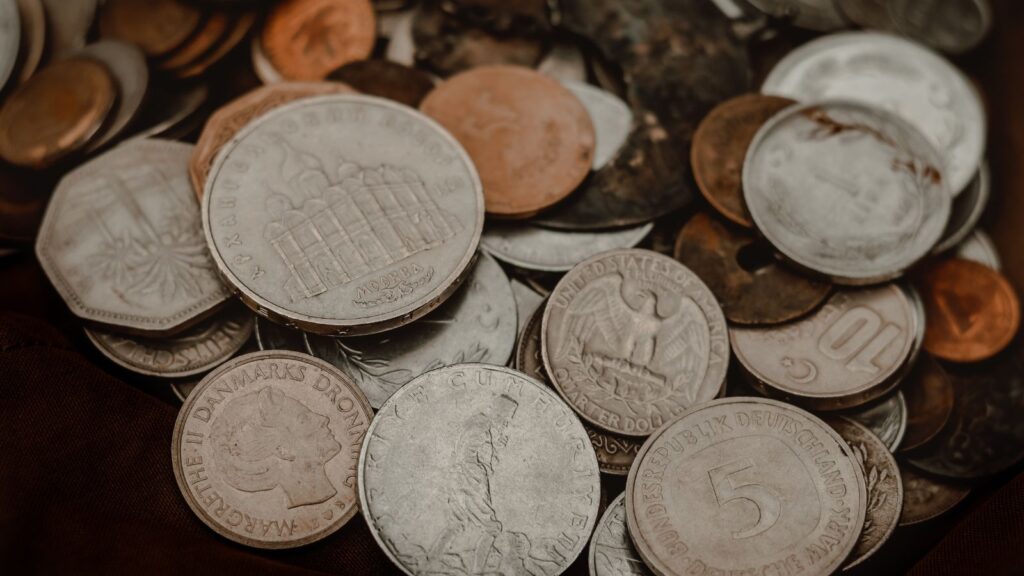
Most people probably don’t give much thought to the old coins sitting in a jar, tucked away in a drawer, or inherited from a family member. But some ordinary-looking coins can be worth far more than their face value.
Collectors regularly search for coins with unusual errors, low production numbers, rare varieties, precious-metal content, or exceptional condition. Some of the most valuable examples have been found in old collections and family keepsakes after sitting unnoticed for decades.
Finding a rare coin shouldn’t be treated as a retirement plan, of course. Still, if you have a box of old coins at home, it may be worth checking them before taking them to the bank or spending them. Here are some of the coins collectors keep an eye out for.
1794 Flowing Hair Half Dollar
The 1794 Flowing Hair half dollar comes from the earliest years of the United States Mint, which gives it plenty of historical appeal on its own. Surviving examples are scarce, and coins in exceptional condition can bring six- or seven-figure prices.
Collectors pay close attention to the coin’s condition, strike quality, and overall preservation. A genuine example in a strong grade would be a remarkable find.
Related: 10 Rare Half Dollar Coins That Can Be Worth Hundreds—or Even Thousands
1838-O Capped Bust Half Dollar
The 1838-O Capped Bust half dollar was among the early half dollars produced at the New Orleans Mint. Only a small number have survived, making this an especially desirable piece for collectors of early American coinage.
Because so few are available, prices can reach into the hundreds of thousands of dollars, with exceptional examples commanding even more.
1919-D Walking Liberty Half Dollar
The Walking Liberty half dollar is already a favorite among collectors because of its detailed design. The 1919-D issue, struck at the Denver Mint, is particularly difficult to find in high grades.
Most examples that have circulated are worth much less than pristine specimens. Coins with strong details, attractive surfaces, and little wear can bring substantial premiums.
1943-D Bronze Lincoln Wheat Cent
The 1943-D bronze cent is one of the great error coins in American collecting. During World War II, the Mint switched from copper cents to zinc-coated steel to conserve copper for the war effort.
A few bronze planchets were apparently left in the production system and ended up being struck with the 1943 date. The Denver example is exceptionally rare and has become one of the most famous Lincoln cents ever found.
A genuine 1943-D bronze cent could be worth more than $1 million, depending on its condition and the results of professional authentication.
1796 Turban Head Gold Quarter Eagle
The 1796 Turban Head gold quarter eagle is an early American gold coin and one of the first quarter eagles issued by the United States Mint.
Only a limited number survive, and collectors prize these coins for both their rarity and their connection to the country’s early monetary history. High-quality examples have brought more than $1 million at auction.
Related: 17 Rare Quarters Worth Some Serious Money
1798 Turban Head Gold Half Eagle
Early American gold coins are a favorite among serious collectors, and the 1798 Turban Head half eagle is particularly scarce.
Only a small number of examples are known today. Their age, limited survival, and historical importance can push prices into the high six figures or even the millions for exceptional pieces.
1870-S Seated Liberty Silver Dollar
The 1870-S Seated Liberty silver dollar is one of those coins that raises plenty of questions among collectors. There is no clear official Mint record explaining its production, yet an example exists and is regarded as one of the rarest U.S. silver dollars.
That unusual history adds to its appeal. A coin with such a limited known population can attract serious attention at auction.
1870-CC Coronet Head Double Eagle
The Carson City Mint produced many coins that are highly sought after today, and the 1870-CC Coronet Head double eagle is a standout.
This $20 gold coin is extremely scarce. Collectors value surviving examples for their rarity, gold content, and connection to the early days of the Carson City Mint. Exceptional specimens can approach or exceed seven figures.
1839 Coronet Head Gold Eagle
The 1839 Coronet Head gold eagle is an early $10 gold coin with a design variation that interests collectors. Examples from this period are difficult to find, particularly in high grades.
Proof examples are even scarcer and have brought prices approaching $2 million at auction.
1927-D Saint-Gaudens Double Eagle
The Saint-Gaudens double eagle is famous for its beautiful design, but the 1927-D issue is especially important to collectors because of its rarity.
Large numbers of U.S. gold coins were melted during the 1930s, leaving far fewer examples of some dates available today. The 1927-D is one of the key rarities in the series, and top examples can sell for well over $1 million.
1932-D Washington Quarter
The 1932-D Washington quarter had a mintage of only 436,800 pieces, making it one of the key dates in the series.
You won’t necessarily find a fortune in every 1932-D quarter. Condition makes a major difference. Worn examples can still carry a healthy premium, while coins with strong details and little wear can be worth thousands of dollars.
Related: The Most Valuable Pennies Still Hiding in Circulation Today
1937 Doubled Die Washington Quarter
The 1937 doubled die Washington quarter is a classic example of how a minting error can turn an otherwise ordinary coin into a collector’s item.
The doubling is visible in parts of the lettering and other design details. The stronger and more obvious the doubling, the more attention the coin tends to receive from collectors.
1872-CC Liberty Seated Quarter
The Carson City Mint struck the 1872-CC Liberty Seated quarter during a period when silver mining was booming in the American West.
Today, the coin is difficult to find, especially in better condition. Collectors who specialize in Carson City issues often seek it out, and high-grade examples can sell for tens of thousands of dollars.
1844 Proof Liberty Seated Quarter
Proof coins were produced with special care for collectors and other recipients rather than for everyday circulation. The 1844 Proof Liberty Seated quarter is extremely scarce, with only a small number of surviving examples.
Its age and limited availability make it a prized addition to an early U.S. coin collection. Well-preserved examples can reach six-figure prices.
2004-D Wisconsin Extra Leaf Quarter
This one is much newer than the other coins on the list, but it became famous for a very different reason.
The 2004-D Wisconsin quarter has an unusual variety showing an extra leaf on the corn stalk on the reverse. The additional leaf appears in two recognized forms, commonly described as the High Leaf and Low Leaf varieties.
These coins became popular after collectors noticed the unusual detail. Values vary widely based on the variety, condition, and current collector demand.
1795 Flowing Hair Silver Dollar With Silver Plug
Early U.S. silver dollars sometimes received silver plugs to bring the planchet up to the required weight before the coin was struck.
The 1795 Flowing Hair dollar with a silver plug is a fascinating example of early Mint practices. Surviving pieces are rare, and collectors can pay six-figure sums for the right combination of rarity, condition, and provenance.
1943 Copper Penny
The 1943 copper cent is one of the most famous error coins in American history.
Most cents that year were made from zinc-coated steel because copper was needed for the war effort. A small number of copper planchets were accidentally struck with the 1943 date.
Authentic examples are extremely scarce and can sell for six figures. Because counterfeit examples exist, professional authentication is especially important with a coin of this value.
1944 Steel Penny
The following year brought the reverse version of the same basic mistake. The Mint returned to copper cents in 1944, but a few leftover steel planchets from the previous year’s production were apparently used.
The result was the rare 1944 steel cent. Genuine examples are highly collectible and can be worth tens of thousands of dollars or more, depending on condition.
1955 Doubled Die Lincoln Cent
The 1955 doubled die Lincoln cent is one of the easiest famous errors for collectors to recognize. The doubling on the date and lettering is strong enough to be visible without specialized equipment.
Because the error is so dramatic, these cents have remained popular for generations. Even circulated examples can be worth far more than one cent, while well-preserved coins can command much higher prices.
1982-D Small Date Copper Penny
The U.S. Mint changed Lincoln cents from a primarily copper composition to copper-plated zinc in 1982. That transition created several varieties that collectors still study today.
The 1982-D Small Date copper cent is especially interesting because it combines the less common Small Date design with a copper planchet. Authentic examples can be worth thousands of dollars.
If you have older coins sitting around the house, don’t assume they’re valuable just because of their age. Most aren’t. But checking dates, mint marks, unusual details, and possible errors can sometimes turn an ordinary coin jar into a surprisingly interesting discovery. For anything that appears rare or valuable, professional authentication is worth the cost before making a sale.