Plant laws in the United States aren’t always as straightforward as people expect. While some plants are perfectly legal to grow anywhere, others are restricted because they spread aggressively, damage local ecosystems, pose health risks, or contain controlled substances.
The rules also change from one state to another. A plant you can legally buy at a nursery in one state could be illegal to sell or plant just across the state line. Before adding an unfamiliar plant to your yard or garden, it’s always smart to check your state’s regulations.
Here are 15 plants that are banned or restricted in parts of the United States.
Kudzu (Pueraria montana)
Kudzu was brought to the United States in the late 1800s and was once promoted as a way to control soil erosion. It didn’t take long for people to realize just how aggressive it could be.
The vine grows at an incredible pace, climbing over trees, fences, utility poles, and abandoned buildings. It can quickly take over entire landscapes, which is why several states limit or prohibit its sale and planting.
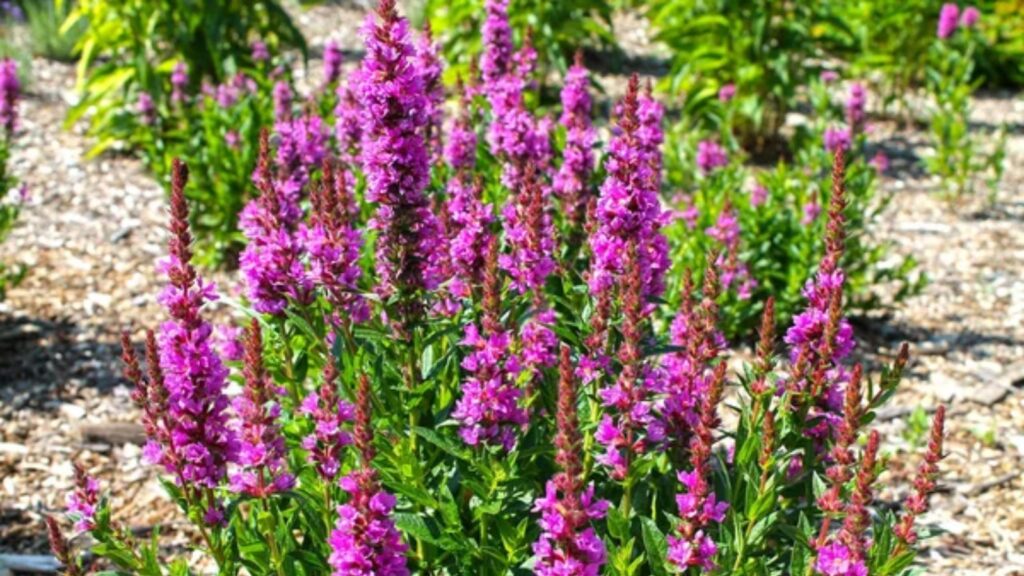
Purple Loosestrife (Lythrum salicaria)
With its tall spikes of purple flowers, purple loosestrife looks like an attractive garden plant. The problem is that it spreads easily once it reaches wetlands.
Large patches can crowd out native plants that wildlife depends on, reducing habitat for birds, insects, and other animals. Because of that, many states have banned its sale or distribution.
Yellow Iris (Iris pseudacorus)
Yellow iris is often planted around ponds because of its bright flowers and ability to grow in wet soil. Left unchecked, it can spread through rivers, marshes, and drainage areas.
Its dense growth pushes out native wetland plants and can interfere with natural waterways. Some states list it as an invasive species and restrict its cultivation.
Giant Hogweed (Heracleum mantegazzianum)
Giant hogweed was introduced as an ornamental plant because of its impressive size, but it comes with a serious hazard.
Its sap can cause painful burns and blisters if it gets on your skin and is exposed to sunlight. The plant also spreads into natural areas, leading several states to regulate or ban it.
Water Hyacinth (Eichhornia crassipes)
Water hyacinth floats on the surface of lakes, ponds, and rivers, producing attractive lavender flowers. It also reproduces at an alarming rate.
Thick mats of the plant block sunlight, lower oxygen levels in the water, and make it difficult for fish and other aquatic life to survive. Many states restrict its sale, transport, or possession.
Giant Reed (Arundo donax)
Giant reed is a tall ornamental grass that can grow more than 20 feet high. While it may look impressive, it spreads aggressively along rivers and streams.
As it expands, it replaces native vegetation and changes natural habitats. Some states have placed limits on growing or selling it because of those concerns.
Peyote (Lophophora williamsii)
Peyote is a small cactus native to parts of Texas, Mexico, and the American Southwest. It naturally contains mescaline, a hallucinogenic compound.
Federal law classifies peyote as a controlled substance. There are limited legal exceptions for certain Native American religious ceremonies, but outside those circumstances, growing or possessing the plant is generally prohibited.
Opium Poppy (Papaver somniferum)
Opium poppies are known for their delicate blooms, and many gardeners admire them for their appearance. They also contain compounds that can be processed into opiates.
Federal law prohibits growing the plants for drug production, and the legal rules surrounding cultivation can be complicated. Their ornamental use falls into a legal gray area, making them a plant many gardeners choose to avoid.
Cannabis (Cannabis spp.)
Cannabis laws have changed dramatically over the last several years, though the legal picture is still far from simple.
Some states allow recreational or medical cultivation under certain rules, while others continue to ban growing the plant altogether. Federal law still classifies cannabis as illegal, so the rules depend heavily on where you live.
Coca Plant (Erythroxylum coca)
The coca plant is native to South America and is the natural source of the compound used to produce cocaine.
While coca leaves have traditional cultural uses in some countries, growing, importing, or possessing the plant is generally prohibited under federal law in the United States.
Salvia divinorum
Salvia divinorum is a member of the mint family that can produce intense hallucinogenic effects when consumed.
Some states allow it, while others prohibit its sale or possession altogether. Several more have placed restrictions on how it can be sold or used.
Khat (Catha edulis)
Khat is a shrub native to East Africa and parts of the Arabian Peninsula. People traditionally chew its leaves for their stimulant effects.
Because the plant contains controlled stimulant compounds, khat is illegal under federal law in the United States.
Kratom (Mitragyna speciosa)
Kratom comes from a tropical tree native to Southeast Asia. Depending on the amount consumed, its leaves may produce either stimulant or sedative effects.
Federal law does not ban kratom nationwide, but several states and local governments have chosen to prohibit or regulate it because of ongoing concerns about safety and misuse.
Jimsonweed (Datura stramonium)
Jimsonweed often grows wild along roadsides and in empty fields. Its trumpet-shaped flowers may catch your eye, but every part of the plant is highly toxic.
Eating it can cause severe poisoning, hallucinations, confusion, and other dangerous medical problems. Some areas discourage cultivation or place restrictions on the plant because of those risks.
Wild Sugarcane (Saccharum spontaneum)
Wild sugarcane is a fast-spreading grass originally from Asia. Once established, it forms thick stands that crowd out native vegetation.
Its aggressive growth has made it a problem in several southern states, leading some of them to restrict its cultivation and sale.