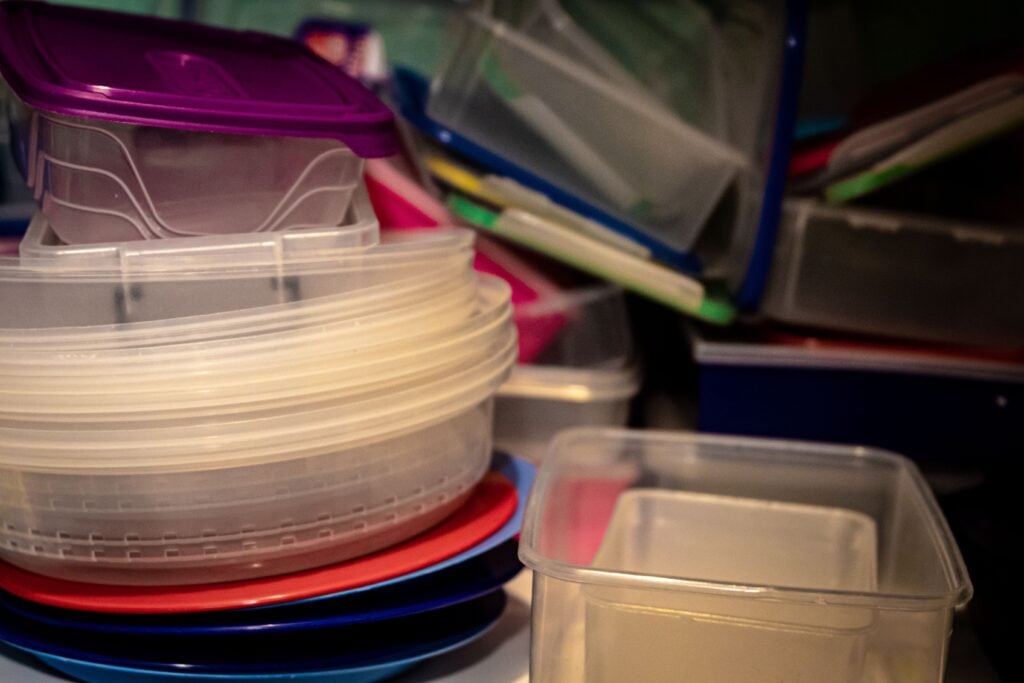
Plastic food containers have a way of multiplying in the kitchen. One gets added for leftovers, another comes home after a takeout order, and before long, there’s an entire cabinet full of mismatched containers and lids.
They’re handy for leftovers, meal prep, packed lunches, and storing ingredients, but they don’t last forever. Frequent washing, dishwasher cycles, microwave use, and everyday wear can eventually leave plastic scratched, warped, cracked, or just plain worn out.
The tricky part is knowing when a container has reached that point. A container can still look usable while showing signs that it’s time to retire it. If you’re sorting through your collection and wondering which ones are still worth keeping, here are some things I would check first.
Deep Scratches or Cracks
A few light scratches aren’t necessarily a reason to throw out a container, but deep scratches are another story. They can make the surface harder to clean and leave plenty of little grooves where food residue can collect.
Cracks are easier to spot and are a much clearer reason to replace a container. A crack can grow with repeated use, especially if the container is exposed to heat or handled roughly. If you see a crack running through the bottom, side, or corner, I wouldn’t keep using that container for food.
Related: 10 Items Most People Store in Plastic Containers (But Shouldn’t)
Punctures or Leaks
There’s not much point in keeping a food container that can’t actually contain food. A small hole or weak spot can turn a container of soup, sauce, or dressing into a mess inside your refrigerator or lunch bag.
Leaking containers are also frustrating to carry around. If liquid starts seeping through the bottom or sides, it’s probably time to retire the container instead of hoping it will hold together for one more use.
A container that leaks when you turn it over or gently squeeze it is especially easy to identify as a problem.
Missing or Warped Lids
A container without its matching lid isn’t necessarily useless, but it can be difficult to store food properly. A good-fitting lid helps keep food covered and makes it much easier to transport leftovers without worrying about spills.
Storing food in a container with a lid that no longer fits can also lead to dried-out food or unwanted odors in the refrigerator. If you’ve been keeping lidless containers in the cabinet for years, this is a good time to decide whether they’re really worth the space.
Heat can also cause lids to warp. If a lid has become bent, cracked, or loose enough that it keeps popping off, the container may have reached the end of its useful life.
Lingering Odors
One of the most annoying things about old plastic containers is how easily they can retain strong food odors. Garlic, onions, curry, tomato sauce, and other strongly scented foods can leave an odor behind long after the container has been washed.
A lingering smell doesn’t automatically mean a container is unsafe. But if you’ve washed it several times and the smell persists, it may be a sign that the container has absorbed food oils and odors over time.
If you open the cabinet and can immediately tell which container once held spaghetti sauce, it might be time to let that one go.
Heavy Staining
Plastic containers can stain easily, especially if you regularly store foods such as tomato sauce, chili, curry, or dishes made with turmeric. A little discoloration isn’t unusual and doesn’t automatically mean the container needs to be replaced.
The bigger issue is when staining is accompanied by scratches, rough spots, a greasy feel, or other signs of wear. At that point, the container may simply be past its best days.
If the container is otherwise smooth, intact, and easy to clean, a stain alone isn’t necessarily a reason to toss it. But if it’s also showing several other signs of age, I’d move it out of the food-storage rotation.
Warping or Changes in Texture
Heat can be hard on plastic containers. Repeated exposure to hot food, the microwave, or a dishwasher can eventually cause a container to change shape.
You might notice that the bottom no longer sits flat, the sides have become slightly crooked, or a lid that used to fit perfectly suddenly doesn’t. Those changes can make the container harder to use and more likely to leak.
Plastic containers that feel brittle, rough, sticky, or unusually thin are also worth a closer look. If the texture has changed noticeably from when you bought it, replacing the container is usually an easy decision.
A Simple Rule of Thumb
You don’t need to throw out every plastic container the moment it develops a small stain or scratch. Instead, look at the overall condition and how well the container still works.
If it’s cracked, leaking, badly warped, deeply scratched, or holding onto odors that won’t go away, there’s little reason to keep it around. A worn-out container isn’t worth taking up valuable cabinet space when a replacement is easy to find.
Cleaning out the old ones can also make your kitchen much easier to manage. Once you’ve gotten rid of the containers that no longer have usable lids or are past their prime, you’re left with a smaller collection that’s much easier to stack, store, and actually use.
Keeping your kitchen stocked with containers in good condition makes everyday food storage much less frustrating.