Grocery shopping is a budget item for almost every household, but where people shop, how often they go, and how much they spend can vary widely. Some prefer buying in bulk to save money, while others stick to stores where they can pick up what they need without spending too much at once.
A recent YouGov survey published looked at how Americans from different income groups shop for groceries, including where they shop, how often they visit the store, and how much they spend each week.
The findings reveal interesting differences, particularly at Costco and Walmart.
Wealthier Americans are more likely to shop at Costco
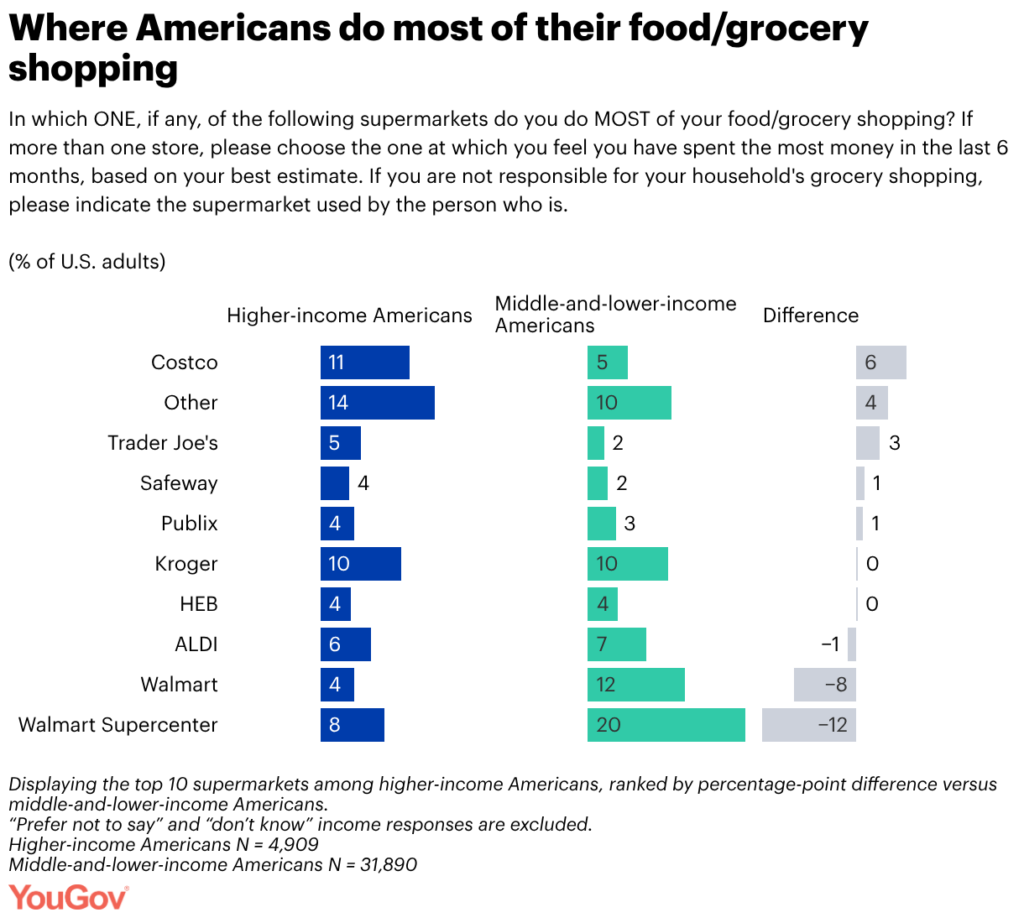
According to the survey, 11% of higher-income Americans say Costco is where they do most of their grocery shopping, compared with just 5% of middle- and lower-income Americans.
Walmart Supercenter shows the opposite trend, with shoppers from middle- and lower-income households more likely to name it as their primary grocery store.
This contrast is interesting, since both retailers are known for competitive prices. Costco focuses on bulk purchases and membership-based shopping, while Walmart offers everyday groceries without requiring a membership.
Of course, shopping at Costco doesn’t necessarily mean spending less. Buying in bulk can offer savings, but it also requires spending more upfront and having enough space to store everything.
Higher-income Americans shop more often and spend more
The survey also found that wealthier Americans tend to make grocery trips more frequently. About a third shop several times a week, compared with roughly a quarter of middle- and lower-income shoppers.
They’re also more likely to have higher weekly grocery bills. About half of higher-income households report spending more than $150 a week on groceries, compared with fewer than a third of other households.
That doesn’t necessarily mean they’re paying more for the same items. Household size, food preferences, and shopping habits can all influence how much a family spends.
What the findings tell us
One interesting takeaway is that having a higher income doesn’t necessarily mean shopping at more expensive grocery stores. Costco, which many shoppers associate with bulk buying and savings, is actually more likely to be the primary grocery store for wealthier Americans.
Meanwhile, Walmart remains a more common choice among middle- and lower-income households.
The survey doesn’t determine which group saves more money. It simply shows how grocery shopping habits can differ depending on household income.
The findings are based on nationally representative YouGov data collected between June 2025 and June 2026.