You start cleaning out a closet or sorting through a drawer, expecting to knock out one more thing on your to-do list. Then you find an old sweater, a handwritten note, a child’s drawing, or some random little item you haven’t seen in years.
And just like that, cleaning turns into a trip down memory lane. You might remember who gave you the sweater, the day your child made that drawing, or the person you were when you bought that item. Suddenly, throwing something away doesn’t feel like throwing away clutter. It feels like you’re throwing away a small piece of your past.
That’s one reason decluttering can be much harder than people expect. Our homes are filled with things tied to people, places, memories, milestones, and different stages of our lives. Sometimes the hardest part isn’t deciding whether we need something. It’s deciding whether we’re ready to let go of what it represents. If you’ve ever gotten emotional while cleaning out your home, there’s nothing strange about it. Here are some reasons it happens and a few ways to make the process a little easier.
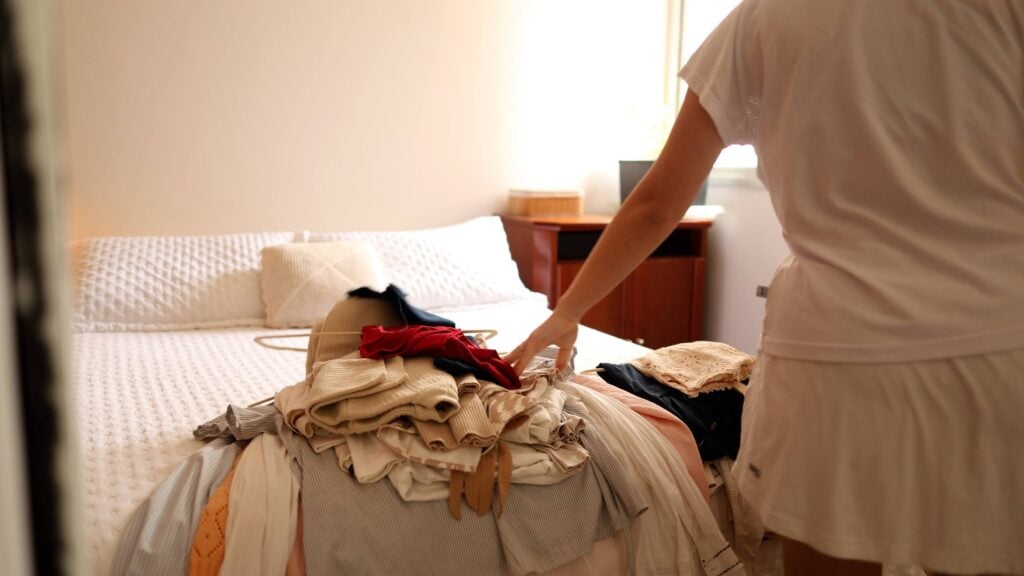
Why Decluttering Can Feel Like Grief
Our stuff can remind us of who we used to be. Maybe there’s a box of baby clothes from when your kids were little. Maybe you have clothes from a job you loved, notebooks from a dream you once had, or gifts from someone who is no longer part of your life.
Getting rid of those things can bring up feelings about how much has changed. Grief isn’t limited to losing a person. It can also come from major life changes, relationships ending, kids growing up, moving away, retirement, or realizing that a certain chapter of your life is over.
That can make a simple decluttering session feel surprisingly heavy. You aren’t being dramatic because an old object makes you emotional. That object may be connected to a part of your life that mattered to you.
Related: The One Decluttering Task Too Many Families Put Off
Name What You’re Actually Feeling
When emotions come up while decluttering, stop for a moment and try to figure out what the item is bringing up. Maybe you’re sad because your kids are grown. Maybe you miss someone. Maybe you’re worried that getting rid of something means you’ll forget an important part of your life.
Try telling yourself, “This isn’t really about this sweater. It reminds me of a time I miss.” That small distinction can make the decision feel less confusing.
You don’t have to talk yourself out of your feelings. You also don’t have to make a decision while you’re upset. Give yourself a few minutes to sit with the memory and let the emotion pass before deciding what to do with the item.
Separate the Memory From the Object
One of the hardest parts of sentimental clutter is feeling like the memory will disappear if the item does. But the object and the memory are two different things.
That old sweater isn’t the person who gave it to you. A child’s drawing isn’t your child’s entire childhood. A stack of old cards isn’t the relationship you had with the people who sent them. The item is a reminder of the memory. The memory itself is still yours.
Sometimes asking yourself, “What am I afraid I’ll lose if I get rid of this?” can help. You might realize you aren’t worried about losing the actual item. You’re worried about forgetting the person, place, or time connected to it. Once you see that, the decision can feel a little less painful.
Related: 5 Reasons Professional Organizers Love the Reverse Decluttering Method
Honor the Memory Before You Let Go
You don’t have to throw something in the trash five seconds after deciding you don’t need it. If an item means a lot to you, take a moment with it first. Look at it. Think about the memory. Write down the story behind it. Take a picture if that helps.
You can also keep one meaningful item instead of an entire box of similar things. For example, if you have dozens of your child’s school projects, you might pick a few favorites rather than keeping every single paper. If you have a whole collection of old concert shirts, you might keep the one that brings back the strongest memory.
A small keepsake box can also give sentimental items a clear home. Once that box is full, you have a natural limit for deciding what stays. The goal isn’t to pretend your past never happened. It’s to make room for your memories without letting every memory take up physical space in your home.
Related: How to Downsize and Declutter Without Regret and Still Keep Sentimental Items
Give Yourself Time to Make the Decision
Some things are easy to get rid of. Others need a little more time. You don’t have to make every decision in the same afternoon. If you’re holding an item and can’t decide, put it in a small “maybe” box and come back to it later.
After a few weeks or months, you may feel differently about it. You might realize you haven’t thought about the item once since putting it away. Or you might realize you really do miss having it around. Either answer tells you something.
What matters is that you aren’t keeping everything just because throwing things away feels uncomfortable. There’s also nothing wrong with keeping something that genuinely brings you joy or reminds you of someone you love. Decluttering doesn’t mean getting rid of everything sentimental.
Accept That Decluttering Can Be Emotional
Decluttering is often shown as a quick process. Fill some boxes, make a donation run, clean the room, and admire the empty shelves. Real life doesn’t always work that way.
You may find yourself sitting on the floor looking through old photographs for an hour. You may cry over a baby blanket you haven’t seen in years. You may need to stop halfway through a closet because you’ve had enough for one day.
That’s okay. Some items are tied to memories that you haven’t thought about in a long time. Cleaning out your home can bring those memories right back. You don’t have to rush through them just so you can say you finished the closet.
Downsizing Can Bring Up Even More Feelings
If you’re moving into a smaller home, clearing out an estate, or getting ready for a major life change, the emotions can be even stronger. You may start wondering what your belongings say about you. Maybe your house has been filled with things from every stage of your life, and now you have to decide which pieces come with you.
That can feel like much more than a storage problem. But you don’t need every school paper to prove you were a good parent. You don’t need every dish from your old kitchen to remember family holidays. You don’t need every notebook from an old dream to prove that dream mattered.
You don’t need every school paper to keep the memories that matter. Your life is bigger than the things you own. Keep the items that still mean something to you. Let go of the things you’re keeping only because you feel guilty, obligated, or afraid that getting rid of them somehow erases the past.
Let Yourself Take It Slow
You don’t have to declutter your entire home in one weekend. Start with something easy. Work on one drawer, one shelf, or one small section of a closet. Save the boxes of old letters and sentimental belongings for a day when you have the time and energy to deal with them.
Take a break when you need one. Some things will be easy to donate. Some will go straight into the trash. Some will sit in a “maybe” pile for months before you know what you want to do.
That’s part of the process. The point of decluttering isn’t to prove how little you can own. It’s to make your home work better for the life you’re living now. And if letting go of something makes you sad, that doesn’t mean you made the wrong choice. Sometimes feeling sad simply means the thing mattered to you.
You can appreciate what something meant without keeping the physical object forever. Your memories, relationships, and experiences don’t disappear just because a box leaves your house.