Every generation has its own habits and keepsakes, but Baby Boomers tend to have a special talent for holding onto things.
Many grew up in homes where repairing something was often the first choice instead of replacing it. If an item still worked, there was usually a good reason to keep it. That mindset can make it hard to toss something simply because newer technology has made it less useful.
Walk through a typical Boomer home and you may find plenty of these old household items. Some sit in cabinets or closets untouched for years. Others still get used because their owners have found ways to give them a purpose.
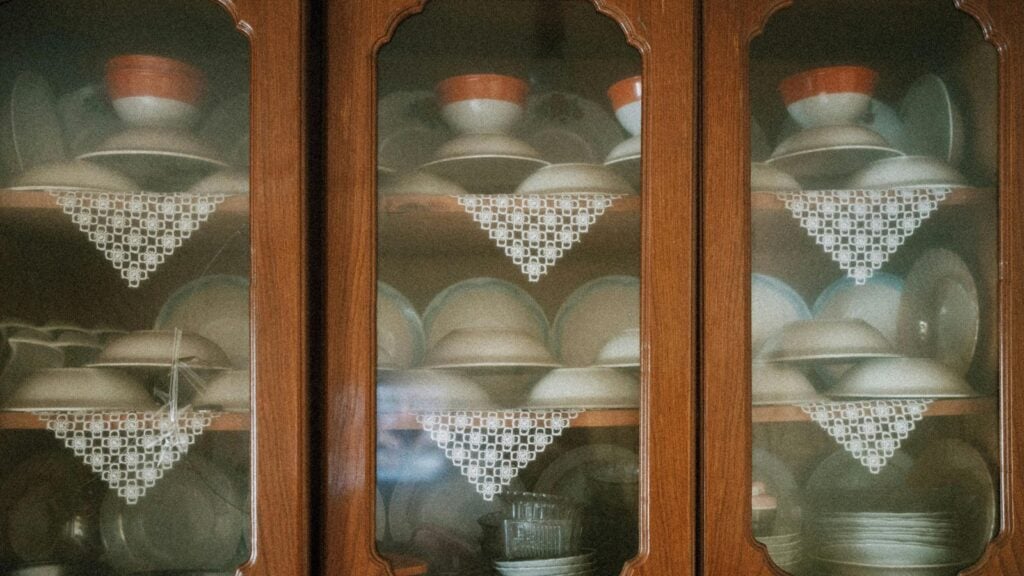
China Cabinets Filled With Special Occasion Dishes
For many Boomers, owning a formal china set was a big deal. Wedding registries commonly included fine china, crystal glasses, serving platters, and other pieces that were saved for Thanksgiving, Christmas, birthdays, and other special occasions.
Those dishes may spend most of the year sitting behind glass doors, but that doesn’t mean they’re ready for the donation box. Many owners associate them with weddings, family dinners, and holidays from years past.
Younger households may prefer dishes that can go from the dishwasher to the table every day, but there’s still something nice about pulling out a special set for a family gathering.
Related: The boldest things people are doing with Dawn dishwashing liquid (it’s not just dishes)
TV Trays
Before large kitchen islands became common, TV trays were a handy way to eat dinner in front of the television. They folded up easily and could be stored in a closet when they weren’t needed.
Some Boomers still keep a stack around for snacks, card games, puzzles, crafts, or the occasional meal in the living room.
They may seem old-fashioned now, but anyone who has ever needed a small portable table knows these things can still come in handy.
Corded Landline Phones
A corded landline phone may look strange sitting next to a smartphone, but some Boomers aren’t giving theirs up.
A traditional phone doesn’t need to be charged, and depending on the telephone service, a corded landline can remain available during certain power outages. For someone who grew up relying on a home phone, having one around can feel like a sensible backup.
Younger family members may laugh at the long coiled cord, but the owner probably sees it as one less thing that needs a battery.
Ceramic Figurines and Decorative Knickknacks
Porcelain animals, ceramic angels, holiday figurines, souvenir pieces, and other small decorations can be found on shelves in plenty of Boomer homes.
Many of these objects have a story behind them. They may have been gifts from friends, souvenirs from vacations, wedding presents, or pieces collected over many years.
Minimalist decorating has become popular, but plenty of Boomers prefer a home filled with things that remind them of people, places, and special occasions.
VHS Tapes and VCRs
The VCR may have disappeared from most modern entertainment centers, but old VHS tapes are still sitting in closets and storage bins everywhere.
Some contain family recordings, children’s birthday parties, school events, home movies, or favorite television programs. Those tapes can be hard to part with because they may contain memories that can’t be replaced.
Even when the VCR no longer works, the tapes often stay put. For many families, getting rid of them feels like getting rid of a piece of their own history.
Related: 12 Classic Vinyl Records In Your Collection That Could Be Worth Serious Money
Encyclopedia Sets
Before Google and smartphones put nearly every answer a few taps away, encyclopedias were a household reference tool.
A complete set could take up an entire bookshelf and cost a fair amount of money. Parents bought them for their children, and students were expected to actually use them for school projects.
Today, those heavy volumes rarely get opened. Still, many Boomers have kept their sets because they remember how useful they once were and how much they cost.
Some are also interesting pieces of publishing history, particularly older or complete editions.
Paper Maps and Road Atlases
GPS has made getting lost on a road trip much harder, but plenty of Boomers still have a paper map tucked into a glove compartment.
There is a practical reason for keeping one. Phones can lose battery, apps can malfunction, and cell service isn’t available everywhere.
There is also the nostalgia factor. For many Boomers, planning a road trip meant spreading a map across the kitchen table, tracing the route with a finger, and marking stops along the way.
Answering Machines
Before voicemail became standard, answering machines sat beside the telephone and recorded messages on tapes or digital storage.
That familiar beep after the outgoing greeting was once part of everyday life. Today, most people don’t need a separate machine because their phones handle missed calls automatically.
Still, some Boomers keep their old answering machines connected or stored away. Like many older technologies, they can bring back memories of a time when people weren’t constantly reachable.
Check Registers
For many Boomers, balancing a checkbook was simply part of managing household money.
Every check, deposit, withdrawal, and payment was written down in a small register so the account balance could be tracked by hand. Online banking has made that process much less common, but some people still prefer having their own written record.
A handwritten register may seem unnecessary to someone who checks a banking app several times a day, but there’s something reassuring about seeing every transaction written down.
Plastic Grocery Bag Collections
There is a good chance that a cabinet, pantry, or drawer in a Boomer home contains a plastic bag stuffed with more plastic bags.
The collection usually starts innocently enough. A few grocery bags are saved for small trash cans, pet waste, packing materials, or messy household jobs. Then more bags get added, and before long, there’s enough plastic to fill a drawer.
Many Boomers have trouble throwing them away because they know they’ll eventually find a use for them. And, in fairness, those bags can be surprisingly handy around the house.
The bigger question is whether the collection has become larger than the number of bags the household could realistically use. A smaller stash can still be useful without taking over an entire cabinet.