A look back at the books behind his most enduring films
Rob Reiner had one of those rare careers where the work never felt accidental. Across genres and decades, his films shared a common thread: they were rooted in strong storytelling. Many of his most iconic movies began as books, plays, or novel stories he trusted enough to bring to the screen without stripping them of their heart.
As news of his passing has settled in, revisiting those original stories feels like a quiet way to honor him, not just by rewatching the films, but by returning to the pages where so many of them began.
Here’s a look back at some of the most memorable book-based stories Rob Reiner brought to life—and why the books themselves are still worth keeping close.
The Body by Stephen King
Adapted into Stand by Me (1986)
Stephen King’s novella is understated, reflective, and deeply personal. It’s less about the journey to find a body and more about how childhood friendships fade over time. Reiner understood that balance instinctively. His adaptation stayed true to the quiet grief and nostalgia embedded in the writing.
Reading The Body now feels especially poignant. It’s a story about memory—how certain moments shape us, and how we carry them long after they’re gone.
The Princess Bride by William Goldman
Adapted into The Princess Bride (1987)
The film became a cultural touchstone, but the book is just as clever, layered, and sincere. William Goldman’s novel plays with structure and storytelling in a way that could have been lost onscreen. Instead, Reiner leaned into it.
The Princess Bride book offers something the movie can’t fully capture: meta-humor, footnotes, and quiet commentary on love and storytelling itself. It’s a reminder of how carefully Reiner chose material that trusted its audience.
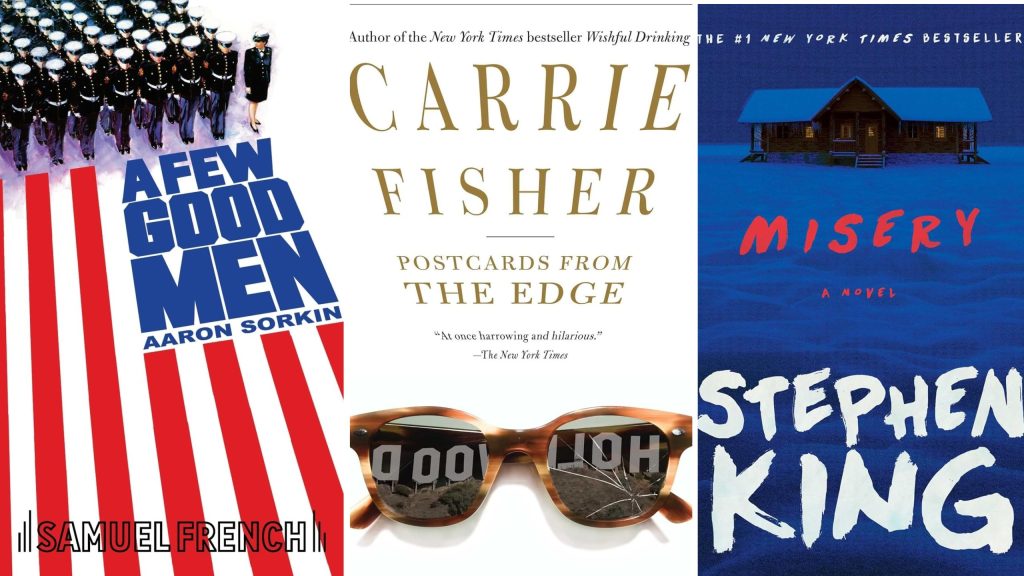
Misery by Stephen King
Adapted into Misery (1990)
On the page, Misery is tense and internal, driven by fear, isolation, and obsession. Reiner resisted the urge to sensationalize it. The result was a restrained, unsettling adaptation that respected the story’s psychological depth.
The novel adds layers of inner monologue and authorial anxiety, deepening the experience. It remains one of the clearest examples of how Reiner honored source material without softening it.
A Few Good Men by Aaron Sorkin
Adapted into A Few Good Men (1992)
Originally written as a play, A Few Good Men is built on dialogue and moral tension. Reiner’s direction gave the story room to breathe while preserving its sharp edges.
Reading the original script or source material highlights how much trust Reiner placed in words. The power of the story comes not from spectacle, but from confrontation, ethics, and consequence.
Flipped by Wendelin Van Draanen
Adapted into Flipped (2010)
Flipped is a quiet novel about first love, and perspective is easy to underestimate. Told from two viewpoints, it explores how people grow by learning to see each other clearly.
Reiner’s adaptation stayed close to the book’s tone, resisting irony or cynicism. The novel itself is worth revisiting for its simplicity and warmth—qualities that defined much of Reiner’s later work.
Postcards from the Edge by Carrie Fisher
Adapted into Postcards from the Edge (1990)
Carrie Fisher’s novel Postcards from the Edge is candid, sharp, and deeply human. While Reiner wasn’t behind the camera for this adaptation, it belongs in the broader conversation about the kind of material he gravitated toward during this era: stories about flawed people navigating complicated relationships.
The book remains a powerful, personal read, shaped by Fisher’s unmistakable voice.